
Enhancing assessment and feedback at scale: The University of Bath's institutional approach


Founded in 1966, the University of Bath is a leading public university in the UK, known for its commitment to academic excellence, research, and student experience. It offers over 190 undergraduate and numerous graduate courses, with around 21,000 students from 152 nationalities. The university fosters a collaborative environment where teaching, learning, and real-world application intersect, preparing students to become global leaders. Bath consistently ranks among the top universities in the UK, earning recognition for the quality of its teaching and student satisfaction, including a prestigious Gold award in the Teaching Excellence Framework (TEF). Its focus on employability is reflected in a strong track record, graduates are highly sought after, with many moving into successful careers or continuing further education soon after completing their studies.
Yvonne Moore
Digital Education Developments Lead University of Bath's Centre for Learning
& Teaching
Yvonne Moore is the Digital Education Developments Lead at the University of Bath's Centre for Learning and Teaching.
With nearly 30 years in education across secondary, further, and higher education, she now focuses on evaluating and implementing learning technologies for effective teaching and learning.
Marie Salter
Head of Technology Enhanced Learning University of Bath's Centre for Learning
& Teaching,
Marie Salter is Head of Technology Enhanced Learning at the University of Bath's Centre for Learning & Teaching, where she leads a team of TEL specialists supporting the university's teaching and learning community.
Her work spans the strategic development of TEL, leading MOOC development in partnership with FutureLearn, and exploring new technologies to enhance the student experience.
Founded in 1966, the University of Bath is a leading public university in the UK, known for its commitment to academic excellence, research, and student experience. It offers over 190 undergraduate and numerous graduate courses, with around 21,000 students from 152 nationalities. The university fosters a collaborative environment where teaching, learning, and real-world application intersect, preparing students to become global leaders. Bath consistently ranks among the top universities in the UK, earning recognition for the quality of its teaching and student satisfaction, including a prestigious Gold award in the Teaching Excellence Framework (TEF). Its focus on employability is reflected in a strong track record, graduates are highly sought after, with many moving into successful careers or continuing further education soon after completing their studies.
Yvonne Moore
Digital Education Developments Lead University of Bath's Centre for Learning
& Teaching
Yvonne Moore is the Digital Education Developments Lead at the University of Bath's Centre for Learning and Teaching.
With nearly 30 years in education across secondary, further, and higher education, she now focuses on evaluating and implementing learning technologies for effective teaching and learning.
Marie Salter
Head of Technology Enhanced Learning University of Bath's Centre for Learning
& Teaching,
Marie Salter is Head of Technology Enhanced Learning at the University of Bath's Centre for Learning & Teaching, where she leads a team of TEL specialists supporting the university's teaching and learning community.
Her work spans the strategic development of TEL, leading MOOC development in partnership with FutureLearn, and exploring new technologies to enhance the student experience.
Context
The University of Bath embarked on a curriculum transformation project (2018–2025) to review and improve complex course structures and integrate innovation into teaching approaches. A key priority of this initiative was to ensure that learning technologies align with the pedagogical needs and aims of the new curriculum.
With a focus on assessment and feedback, Bath looked to address limitations in their existing toolset by implementing solutions that would help staff create and manage peer assessment and group activities efficiently while providing quality feedback to students. To support these efforts, the university introduced FeedbackFruits, designed to enhance peer review and support formative assessments.


Assessment of learning outcomes
Notable outcomes
Scaling feedback and learning for large, diverse cohorts
Managing assessments and feedback for large, diverse cohorts presents significant challenges. FeedbackFruits offered a solution to streamline feedback processes, facilitate peer learning, and scale assessments effectively.
Bath introduced a pilot in February 2023, which concluded in June 2025. Following a positive evaluation involving staff and student feedback, the Faculty of Engineering and Design chose to adopt the platform across its four departments.
"We've seen the most interest in areas like peer review, group work, and group member evaluation."
— Yvonne Moore, Technology Enhanced Learning team
Use-cases from the pilot
Use Case 1: Distance Learning Programme: MA Education
Learning Activity: Peer Review
The online course in Education struggled to foster interaction among students due to limited in-person contact. The course adopted the Peer Review solution from FeedbackFruits, encouraging students to engage with each other's work through structured assessments. This promoted collaboration and meaningful learning, even in a remote setting.
Use Case 2: Pre-Sessional Courses for International Students Programme: Pre-Sessional English
Learning Activity: AI Feedback Coach
International students preparing for academic life in the UK required frequent practice in academic writing. With limited teacher involvement, the course introduced the AI Feedback Coach from FeedbackFruits. The AI-powered feature provided students with instant, formative, actionable feedback on technical aspects such as grammar, references, and vocabulary, allowing them to refine their skills independently while remaining engaged throughout the course. It also helped instructors save time on feedback, allowing them to focus more on developing students' higher-order thinking skills such as analysis, evaluation, and synthesis.
Use Case 3: Group Work in Pharmacy Programme: Pharmacy
Learning Activity: Group Member Evaluation
Group projects in the pharmacy course posed challenges around fair grading and workload distribution. The course adopted the Group Member Evaluation solution, which allowed students to assess their own and their peers' contributions. This ensured accountability and promoted fair grading, reducing conflicts within group settings.
Use Case 4: Assessment Literacy in Sports Management and Coaching Programme: Sports Management and Coaching
Learning Activity: Peer Review
In the sports courses, engaging students early with marking criteria was crucial for developing assessment literacy. This approach encouraged peer-led learning and self-reflection. Students provided feedback on their peers' work and gained insights from comparing their submissions to others.
"As a complete novice, I found it easy to set up and coordinate. When a student had an issue in class, I used the chat function, and within minutes, the problem was resolved in real time. This enhanced the student experience because if I couldn't help them immediately, they wouldn't have been able to engage with the task."
— Dr Lucy Noble, Director of Teaching, Department for Health
Expanding across engineering and design
Following the pilot, the Faculty of Engineering and Design adopted the Feedback and Assessment solution, which includes seven distinct activities. Peer Review and Group Member Evaluation remain the most widely used. The platform is integrated into Bath's Moodle environment via LTI, with the flexibility to expand access to other faculties in the future.
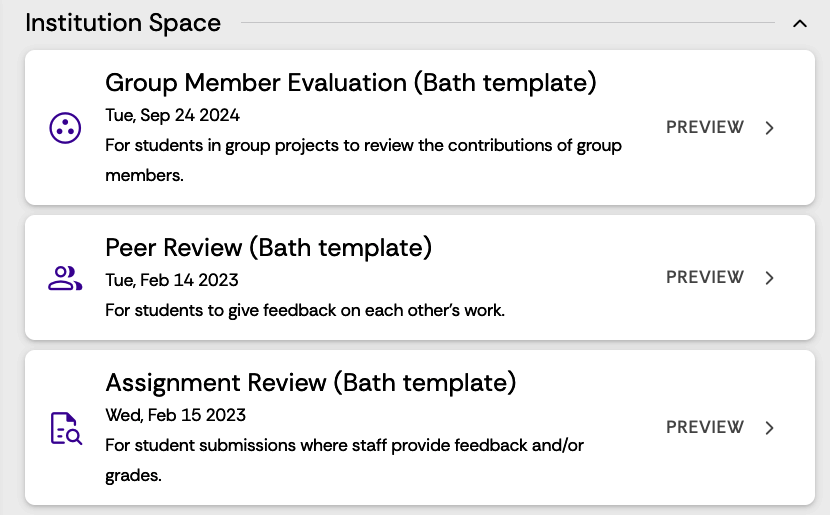
Engineering courses have evolved to include a range of group project work, simulating real-world professional environments. Managing these projects at scale is an ongoing challenge that FeedbackFruits directly supports, as illustrated across three departments:
Chemical Engineering
Dr Stuart Scott uses Group Member Evaluation for regular check-ins on Year 3 design projects, with an initial 2-week formative period followed by five weeks of self and peer assessment. This gives supervisors an evidence base for early conflict resolution and helps students develop group work and peer review as professional skills alongside subject knowledge.
Architecture
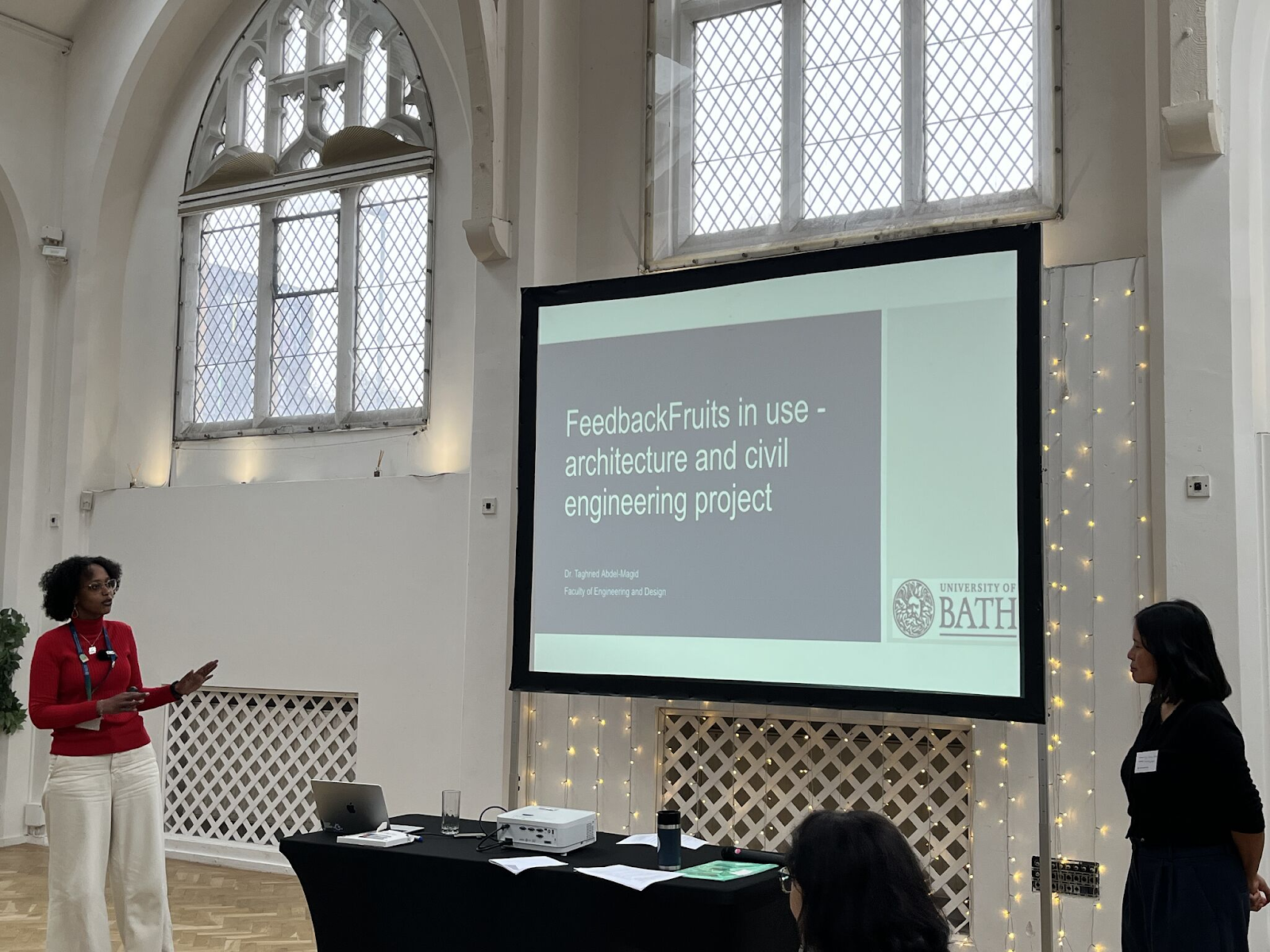
Dr Taghried Abdelmagid runs structured peer feedback activities in first-year Engineering, where students develop a design, give and receive peer feedback, then attempt to build a peer's design. This tests whether ideas were communicated clearly enough to be executed as intended.
Mechanical Engineering
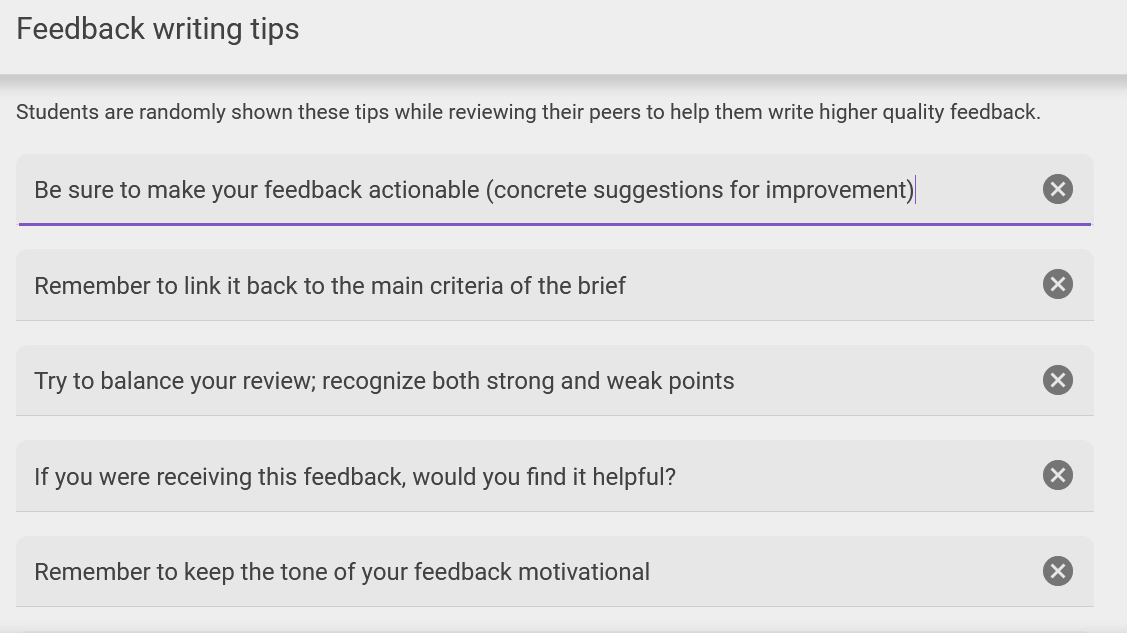
Dr Anna Young uses Peer Review in two large first-year cohorts for practice exams ahead of end-of-year assessments. Students review their own work and two peers' submissions anonymously against rubrics, gaining insight into marking criteria and their performance relative to the cohort.
Ongoing developments
Staff in the Faculty of Engineering and Design are now sharing their practice with colleagues across the university and the wider sector, including participation in a UK-wide Community of Practice, faculty-wide training and discussion around assessment and feedback, and dedicated training sessions across the faculty.
Conclusion
The University of Bath's experience demonstrates how the right technology, deployed within a clear pedagogical framework, can transform assessment and feedback at scale. From remote postgraduate learners to large undergraduate engineering cohorts, FeedbackFruits has enabled Bath to build consistent, meaningful, and scalable feedback practices across disciplines. As adoption continues to grow, the university is well positioned to extend these benefits across more faculties and programmes.
Possible variation


.avif)
.avif)
.avif)


